She Googled “How to Start a Nonprofit.” Now Imani Black Is Building a Path Into Aquaculture for Everyone.
July 25, 2026

Apple Podcasts | Spotify
In 2020, Imani Black was washing dishes after a long day of oyster farming when a Netflix show happened to be playing in the background. Within the first six minutes, she saw something she’d never seen in her entire career: a Black oyster farmer.
She rewound it maybe twenty times, convinced she wasn’t seeing it right. That single moment set off a chain of events that turned a woman who once thought she’d farm oysters for the next twenty years into the founder of a global nonprofit.
This week, I sat down with Imani to trace how that spark became Minorities in Aquaculture, and why she’s now willing to say some uncomfortable things out loud.
Meet Imani Black
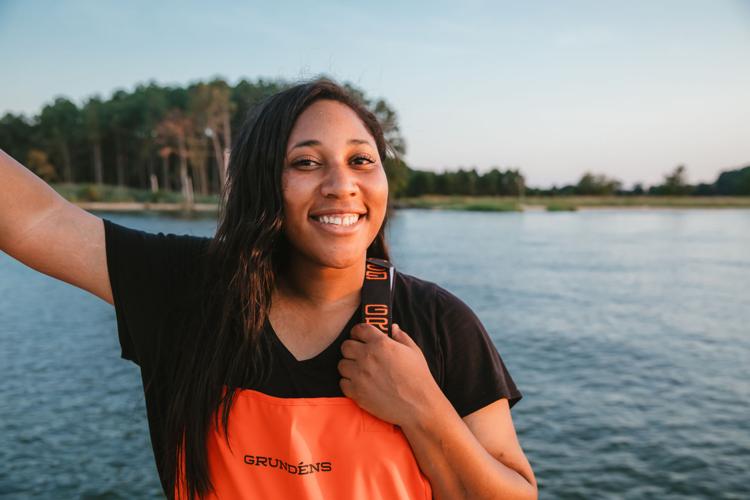
Imani Black is the founder of Minorities in Aquaculture (MIA), a workforce development nonprofit she started in 2020 after roughly five years as a commercial oyster farmer in Maryland and Virginia.
Born and raised on the Eastern Shore of Maryland, seafood was, as she puts it, “ingrained into my DNA.” She found her path through an internship with the Chesapeake Bay Foundation and the oyster aquaculture training program at the Virginia Institute of Marine Science.
Minorities in Aquaculture began as one of the only DEI organizations in aquaculture, and has grown into a global network of around 600 members, with an internship program placing students on farms across the country. She’s also a self-described oyster enthusiast, a dreamer-and-doer, and the author of a recent article that’s stirred up some very necessary conversation in the industry.
In this episode, we get into…
- Why seeing one Black oyster farmer on a Netflix show completely rerouted Imani’s career
- The cold email she sent with (by her own admission) barely any punctuation — and the reply that changed everything
- What a Maryland oyster farmer meant by “a speck of pepper and a sea of salt”
- The three things Imani actually looks for when she reads an oyster menu (and the one thing she begs restaurants to stop doing)
- How MIA quietly outgrew the “DEI box” and became something she’d rather call workforce development
- The article that “caused quite a stir” — and the difference between saying you want representation and actually making room for it
- Why she thinks running a nonprofit might be harder than running a for-profit business
Lessons from My Chat with Imani
1. Aquaculture is conservation, not a separate thing from it.
One of the most impactful moments of this conversation is Imani’s insistence that farming shellfish isn’t in tension with protecting the ocean. She frames oyster farming as commercial production, restoration, and conservation all wrapped into one, and pushes back on the idea that the sustainable choice is to stop eating seafood altogether.
We get into why that “just go vegan” framing misses entire coastal communities, and what getting involved actually looks like if you’re starting from zero.
2. Representation is a first step, not the finish line.
Imani’s recent column in Aquaculture North America argues for a cultural shift in ocean industries, and she walks through what she means: not public shaming, but public accountability. She’s careful and generous about it, crediting the women who came before her, insisting this isn’t about excluding men, while still naming that some things in the room haven’t changed.
I’ll let her explain the distinction herself, because the nuance is the whole point.
3. You have to “kill” a version of yourself to keep going.
Some of the most honest moments here are about the founder’s interior life: the roadblocks that preceded MIA, the grief of trading the water for a laptop, and a quote she both loves and hates about how no one can prepare you for the step you’re about to take.
If you’ve ever sat on an idea because the beginning felt too uncomfortable, this stretch of the episode is for you.
Learn More About Imani & MIA
- Minorities in Aquaculture (MIA) — become a member (free for women, women of color, and gender minorities in aquaculture) or a champion
- Imani’s article Aquaculture North America: “We Don’t Need More Women’s Panels. We Need a Culture Shift.”
- Follow Imani on Instagram
More Links from the Episode
- Chesapeake Bay Foundation — where Imani’s oyster restoration spark first caught
- Virginia Institute of Marine Science and its Oyster Aquaculture Training (OAT) program
- Oyster Master Guild — oyster sommelier certification courses, led by oyster blogger Julie Chu and Chef Patrick
- McIntosh & Sons Oyster Farm — Savannah, GA
- Chef’s Table (Netflix) — Chef Mashama Bailey’s episode is Season 6, Episode 1
Enjoyed This Episode?
Did this episode resonate with you? Help the show reach even more ocean lovers!
⭐ Leave a rating/review/comment on Apple Podcasts, Spotify, or YouTube — it’s the single biggest thing that helps people find the show.
💬 Share it with one friend who’s been talking about wanting to do something for the ocean.
🌊 Follow the show so you don’t miss the next episode.
And come hang out with me on Instagram! I’d love to hear what you thought of this episode!

« Previous Post
Next Post »
Leave a Reply
Latest Episodes
catch up on the