His Films Helped Create a National Park. Now Wildlife Cinematographer Erick Higuera is Aiming His Camera at Hammerheads.
July 16, 2026

Apple Podcasts | Spotify
What an honor it was to sit down with Erick Higuera, a man whose work you’ve probably seen before… even without knowing it. Have you watched Planet Earth III, Our Oceans with Barack Obama, or Ocean with David Attenborough? Then you’ve witnessed some of Erick’s incredible film work.
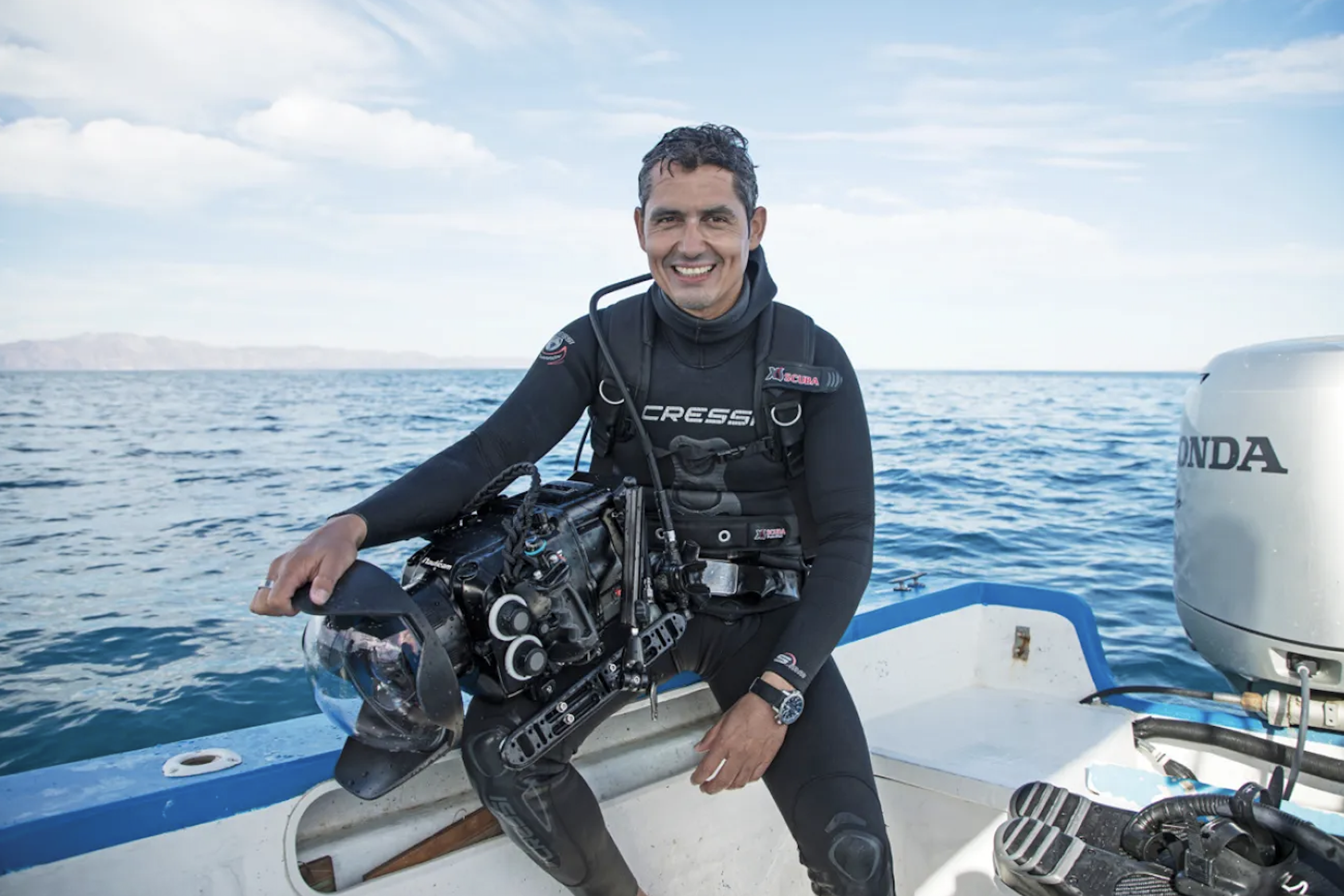
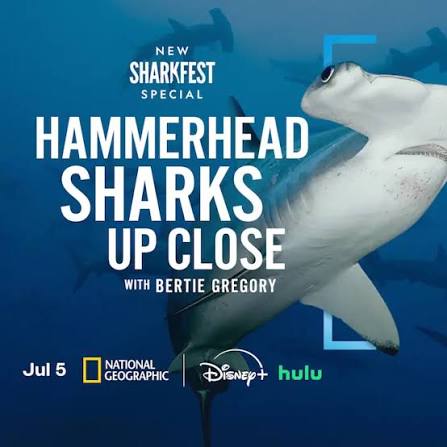
Erick’s a rockstar cinematographer, marine biologist, diver, and dad who’s spent more than half his life in Baja California, Mexico. His work has appeared in many nature documentaries from giants such as National Geographic, the BBC, and the Discovery Channel. Most recently, he worked on Hammerhead Sharks Up Close with Bertie Gregory which is now streaming on Disney+.
“The Mexican Pacific is my passion,” he says, and by the end of this episode, you’ll be ready to buy your flight to go and see it for yourself.
How Erick Got His Start in Marine Biology and Cinematography
Erick didn’t take a straight line into marine biology. He was two and a half years into a mechanical engineering degree before he switched (something I can totally relate to!) Then, when he found out dive training wasn’t part of the curriculum, he dropped out entirely to become a dive instructor.
For two years, he guided and taught in the Bay of La Paz. He was doing exactly what he’d always wanted to do. There was just no science in it at all.
His mom’s take was a tad brutal: a dive certification is a diploma you buy, not a degree you earn. After two years, he went back and finished his marine biology degree. Things seemed to fall into place for him after that. He was already in the water watching the amazing animals of the Mexican Pacific, and now he was equipped to study them, too.
The cinematography wasn’t planned either. His job on a dive liveaboard came with one extra duty: film the guests, cut a video, and hand them a DVD at the end of the trip.
He’d wanted to shoot stills, but in the late nineties, there was no competing with the underwater photographers who were already established. So he shot video instead, and as the footage piled up, he gained valuable experience.
Around 2010, the BBC came looking for giant mantas and schools of sharks in Revillagigedo National Park. Three years of emails later, the expedition finally happened. The rest is (natural) history. He’s never taken a cinematography class in his life.
Watching the Mexican Pacific Waters Change with Time
Erick’s been diving this region since 1997, which means he’s watched the whole curve of ecosystem change: down and back up again. When he started, the hammerheads were everywhere. The captains and dive masters who trained him talked about the mid-eighties like it was a different planet, teeming with life.
Then, within five or six years, the schools were thinner. Then thinner again. It wasn’t a crash, but rather a slow erosion. It was the same with the mobula rays, and the same with the big schools of fish. You only notice this kind of decline if you’re in the water every day for years, as Erick has been.
The giant mantas are perhaps the clearest example. In 2002, it was practically a guarantee to see them. Then in 2003, nothing. And then nothing for fifteen more years.
But Erick has seen the other direction, too. His ecology class visited Cabo Pulmo in 1997 (three years after it was protected), and there was essentially nothing there. A few fish, but not much else. The whole point of the trip was to watch a fished-out village put all its bets on protection and see what happened.
About a decade later, the first hopeful signs showed up. Predators were returning. Abundance began to flood back in. It’s now one of the most successful marine protected areas in the world, and it became the argument for everywhere else: if it can work in Cabo Pulmo, why can’t it work elsewhere?
The mantas did eventually come back, but it took until 2018. Sixteen years. Protection works, but species and ecosystems simply need time to recover.
The Wonders of Revillagigedo and How Imagery Got it Protected
This is the part Erick keeps coming back to, and it started almost by accident. He was filming divers and marine life so tourists could take a DVD home from their trip. But he was also putting some of that stock footage online, and on whatever social platforms existed at the time. It grew fast.
The dive company noticed and started using the imagery to market the Revillagigedo Archipelago and Guadalupe Island. Other operators saw it working and did the same. The images kept circulating, and the audience kept getting bigger.
Eventually, it reached UNESCO and the other organizations that help places win protection. Attention grew, more data were gathered, and it went up the chain. Revillagigedo became a World Heritage Site in 2016 and a national park in 2017, which means fishing is banned outright and the protected area was expanded. Today, it is North America’s largest fully protected marine reserve.
The same logic brought the mantas back. When the juveniles returned to La Reina in 2018, Erick and scientists including Dr. Mauricio Hoyos and Dr. James Ketchum formed the Manta Pacifico Collective.
They promoted it, the community showed up, and they wrote a code of conduct together. “It worked one hundred percent,” Erick said. There’s been visceral awareness around those mantas ever since.
So why aren’t hammerheads protected?
Mexico protects three shark species: great whites, whale sharks, and basking sharks. That’s the whole list.
Erick’s read is that the obstacle isn’t evidence. The data on scalloped hammerheads already exist, and if someone wants more, more can be produced. The real challenges are politics, economics, and fisheries. But it’s clear these challenges need to be overcome.
Mexico has Cabo Pulmo and Revillagigedo to prove that protection works. Erick thinks hammerheads will be protected in perhaps five or ten years.
The unique challenges the hammerheads face and the peril they’re in made them a perfect star for the new documentary, Hammerhead Sharks Up Close with Bertie Gregory. In fact, Erick suggested featuring hammerheads over silky sharks: the fishing pressure is worse, and a global audience is exactly the leverage that’s been missing.

Erick’s Incredible Underwater Experiences with Orca Whales
In 2006, at Roca Partida in Revillagigedo National Park, Erick watched a humpback mother hovering motionless at sixty feet with her calf. He said it was one of the best moments of his life.
The same individual came back in 2008, 2010, and 2013, all confirmed by matching photos against the original footage. In 2013, they spent three months with her while the calf practiced its buoyancy.
She returned in 2015 with another calf. On the second day, two orcas took her calf in front of their eyes.
Erick was at a crossroads right then: stay in diving and film, or leave for something else. Watching that hunt, he knew he would stay.
He had wanted to film orcas hunting mobula rays, the thing old captains had described for years, and he’d half-assumed was legend. But orcas are hard to find, so he went after the prey instead. He learned to find the mobulas, dive with them, understand them, and then, eventually, the predator shows up.
It took eight years of triangulating information from fishers and old dive colleagues up and down the Baja coast. In 2018, he filmed a sequence of the orcas hunting mobula rays. That sequence is in the Ocean episode of Planet Earth III.
Erick is completely fascinated with orca behavior and believes that orcas of Baja California are their own special ecotype. This led him to start the Orcas Mexico project.
Balancing an Ocean Career with Family Life
Erick’s a family guy now, and he doesn’t pretend this part is easy. “It’s tough, “he says, “but not impossible. It’s complicated if you want to make it complicated.”
Two things make it work: being present as a parent and making your family part of your life instead of something you leave on shore.
You also need a partner who gets it, and his does. He calls her the brain of the house and himself the workhorse. He does the fieldwork and the animal behavior, she handles the stable isotopes and the movement data. He says he learned how to do proper science from her.
The real proof is his five-year-old, whose first word was “orca.” Not “papa.” Orca. He’d been going out filming them, talking about nothing else, and his kiddo just picked it up. He’s five years old and he’s already done his first pool dive.
Erick doesn’t see science and film as two jobs at all, and he doesn’t see his family as separate and aside from his work. “Good cinematography,” he says, “requires understanding animal behavior well enough to anticipate the action.” And raising a family while doing such work is only made better by sharing your passions with them.
Erick’s Latest Project: Hammerhead Sharks Up Close with Bertie Gregory
Erick’s latest project saw him working and diving alongside other scientists, filmmakers, and Mexican locals to capture incredible footage of hammerhead sharks in Revillagigedo National Park. You can watch the documantary now on Disney+.
Connect with Erick
- Erick’s website: erickhiguera.com
- Follow Erick on Instagram: @erick.higuera
- Check out Erick’s Vimeo
- Dive into Erick’s scientific research on ResearchGate and Google Scholar
Links from the Episode
- Watch Hammerhead Sharks Up Close with Bertie Gregory – now streaming
- Manta Pacifico Collective
- Orcas Mexico
Enjoyed This Episode?
If this episode resonated with you, please consider:
⭐ Leaving a rating/review/comment on Apple Podcasts, Spotify, or YouTube — it’s the single biggest thing that helps people find the show.
💬 Sharing it with one friend who’s been talking about wanting to do something for the ocean.
🌊 Following the show so you don’t miss the next episode.
And come hang out with me on Instagram! I’d love to hear what you thought of this episode!

« Previous Post
Next Post »
Leave a Reply
Latest Episodes
catch up on the